
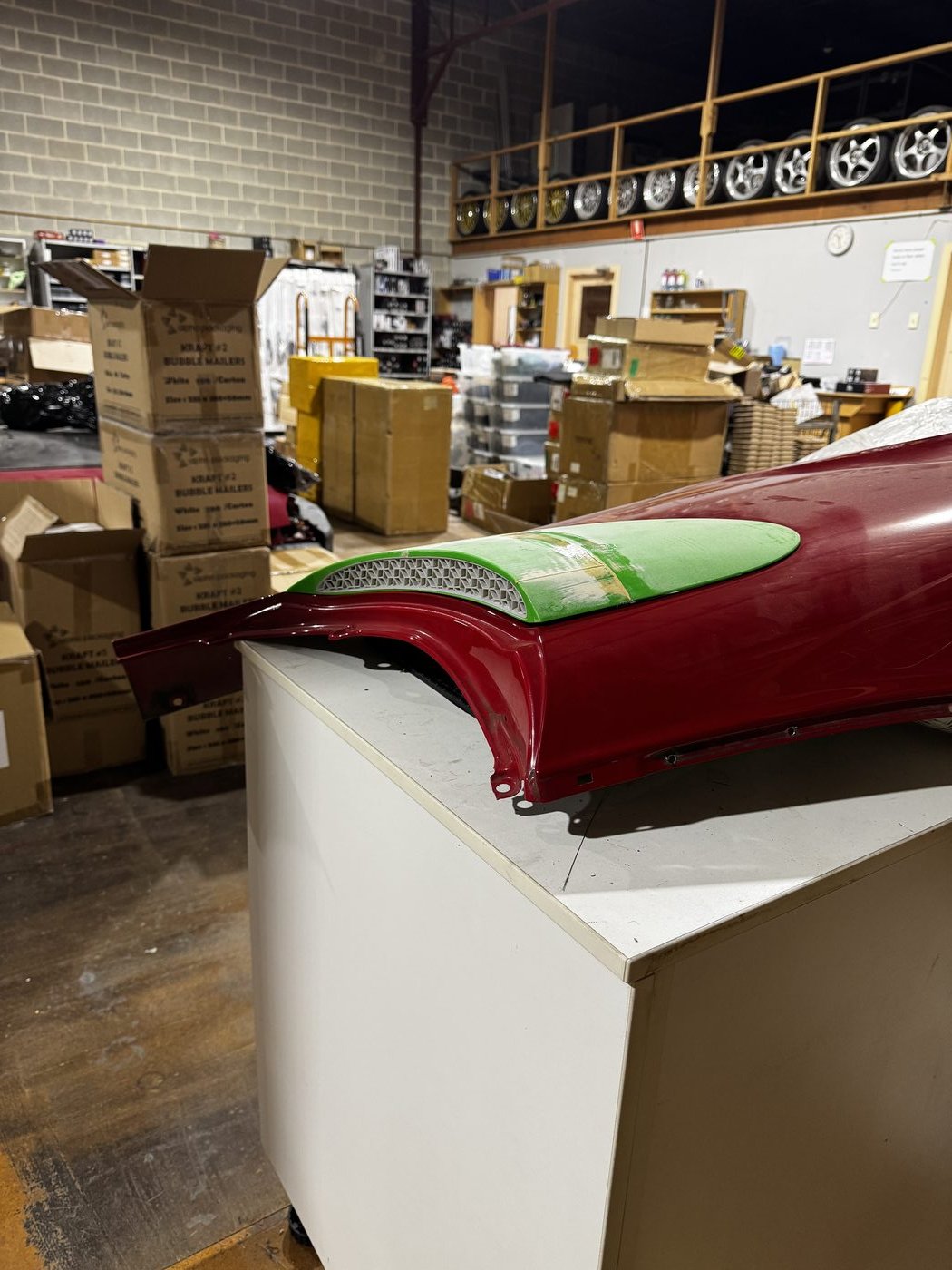
3D car design is the process of turning a real car into an accurate digital model and designing new parts directly against it. For custom body kits and aero parts it means every surface, gap and mounting point is checked digitally before anything is made.
Here is how the process works at C1 Studio, from the first scan to a part fitted on the car.
Step 1: 3D Scanning the Car
The car is 3D scanned to capture its actual surface geometry. Real cars rarely match factory drawings exactly: bodies are not perfectly symmetric and tolerances vary. Scanning the vehicle itself is what makes a design fit the car rather than just look right on screen.
Step 2: CAD Modelling on the Scan
New parts are modelled in professional CAD surface-modelling software directly on top of the scan. Every line is deliberate and original. Nothing is resized from another platform, and gaps, returns and mounting points are dialled in at this stage.
Step 3: Renders and Sign-off
Before anything physical is made, the design is rendered on the car so you can see how it sits with the body lines and approve it, or send it back for revisions.
Step 4: 3D Printed Prototypes
The approved design is prototyped, often 3D printed, so fitment, stance and proportions can be checked on the real car. Changes at this stage are cheap. Changes after a mould is cut are not.
Step 5: Production
- Large panels: a production mould is made and the part is hand-laid in fibreglass, finished primer-ready.
- Small parts: vents, ducts, brackets and trim can be 3D printed as finished parts in engineering-grade ABS.
- Design-only: finished CAD files can be supplied for CNC cutting, 3D printing or local fabrication.
Why 3D Car Design Matters
The difference between a custom part that installs cleanly and one that needs hours of trimming and filling is almost always the data it was designed from. Designing on a scan of the actual car moves the fitment work into CAD, where it is precise and repeatable.
Learn more about our body kit design and 3D car design service, or see how we use 3D printing for prototypes and finished parts.